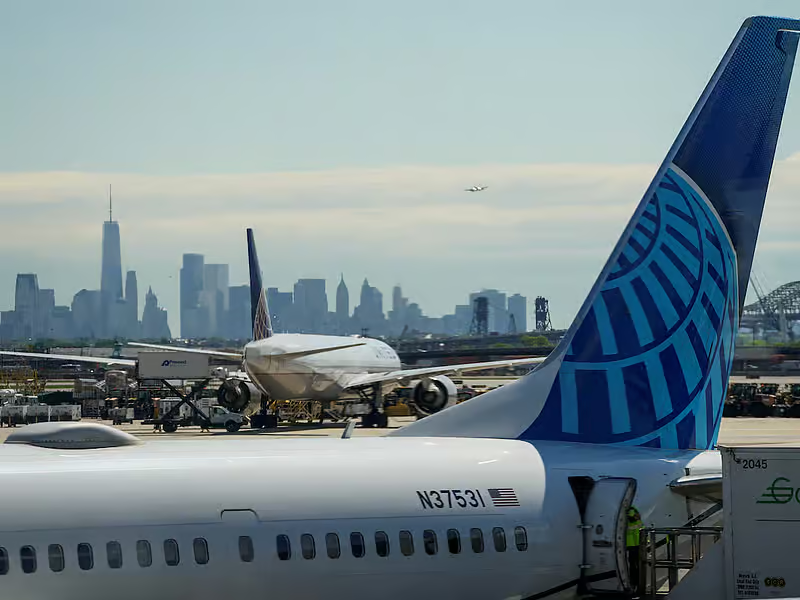
Major disruption hits US aviation network
Thousands of flights across the United States were disrupted after a telecommunications failure affected air-traffic operations, creating delays and temporary restrictions at several major airports.
The disruption affected incoming flights at important East Coast aviation hubs for hours before the Federal Aviation Administration resolved the telecommunications problem, Reuters reported.
The incident demonstrated how failures in communications infrastructure can rapidly spread through a highly interconnected aviation system.
Air-traffic controllers depend on reliable telecommunications systems to coordinate aircraft movements, exchange information and maintain safe separation between flights.
When critical communications infrastructure becomes unavailable, authorities may slow or temporarily stop certain operations as a safety precaution.
Delays can spread nationwide
Even when an infrastructure problem is geographically concentrated, disruption at major airports can quickly affect flights elsewhere.
Aircraft scheduled to arrive at an affected airport may remain at their departure points, while aircraft and flight crews arriving late can subsequently miss their next scheduled services.
This creates a cascading effect in which delays continue after the original technical problem has been resolved.
New York-area airports are particularly significant because they handle large volumes of domestic and international traffic and connect passengers with destinations across the world.
Reports indicated that a fibre-line or telecommunications circuit problem contributed to the disruption affecting the region.
Attention turns to resilience
The incident is likely to renew attention on the resilience and redundancy of communications infrastructure supporting US air-traffic management.
Modern aviation depends on multiple interconnected technologies, ranging from radar and navigation systems to telecommunications networks and airline scheduling platforms.
Infrastructure failures therefore have implications extending beyond individual airports.
Although the FAA resolved the immediate telecommunications issue, passengers can continue experiencing delays while airlines reposition aircraft, crews and passengers across their networks.
Travellers scheduled to fly through affected airports should continue checking directly with their airlines for updated departure and arrival information.
The disruption also illustrates why aviation authorities build operational safeguards around critical systems: when communication reliability becomes uncertain, reducing traffic can be necessary until normal functionality has been confirmed.
Investigations into the precise cause and operational impact of the failure may provide additional information about measures needed to prevent similar large-scale disruption.