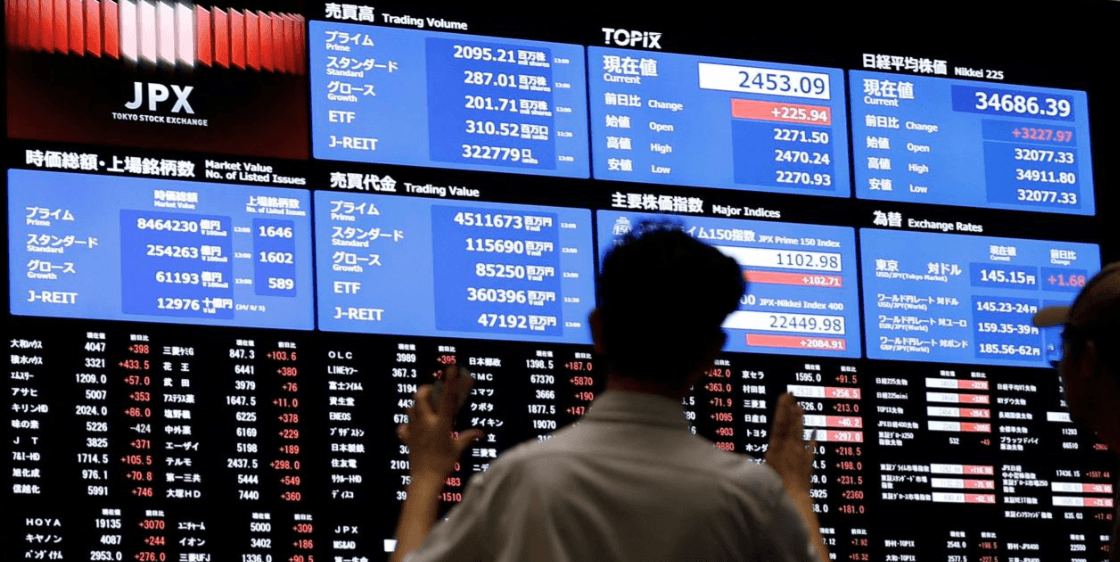
Global financial markets entered Wednesday's trading session under renewed pressure as investors assessed elevated oil prices, recovering technology stocks and the potential implications of upcoming United States inflation data.
Asian equities showed signs of stabilisation following recent weakness in semiconductor-related companies, although the broader market environment remained sensitive to developments in energy prices and monetary policy.
Reuters reported that the MSCI Asia-Pacific index excluding Japan rose approximately 0.8%, recovering from a ten-week low as technology-related shares attracted renewed buying interest.
Major semiconductor businesses, including Samsung Electronics, SK Hynix and Taiwan Semiconductor Manufacturing Company, were among the companies attracting investor attention.
The recovery reflected continuing interest in artificial intelligence infrastructure and advanced computing technology, sectors that have received substantial investment in recent years.
Nevertheless, the improvement in equity sentiment did not eliminate concerns about the sustainability of high technology valuations. Investors are increasingly examining whether companies investing heavily in artificial intelligence can generate sufficient earnings to justify their spending.
Energy markets presented another source of uncertainty.
Brent crude traded above $106 a barrel during Asian trading, while US crude prices remained close to $95, according to market reports. Higher oil prices can increase transport, manufacturing and distribution costs across the global economy.
For energy-importing countries, sustained increases may also place pressure on household spending, business profitability and national inflation rates. The situation is particularly significant for developing economies that rely heavily on imported refined petroleum products or have currencies sensitive to changes in international financial conditions.
Attention is now turning to the latest US consumer price index figures, which investors will use to assess the likely direction of Federal Reserve interest rate policy.
Market forecasts cited by Reuters pointed to annual headline inflation of approximately 3.6% for September, although the actual figures had not yet been released at the time of the report.
A stronger-than-expected inflation reading could reinforce expectations that interest rates will remain elevated or increase further. Alternatively, weaker inflation could improve sentiment towards equities and other assets sensitive to borrowing costs.
Currency markets are also responding to these expectations, with movements in the US dollar influencing international trade, commodity prices and investment flows.
For global businesses, the combination of expensive energy and restrictive financial conditions creates uncertainty around operating costs and investment decisions.
The coming trading sessions may therefore be particularly important for investors seeking clearer signals about inflation, corporate earnings and the durability of the technology-sector recovery.